

Understand your operating numbers · Part 4 of 6
Rental cash flow: what is actually left after the bills?
Bridge rental NOI to owner cash flow after debt payments, capital work, and reserves. Use a worked CAD example to understand what is available before tax.

Rental cash flow is the money left from a property's activity after the cash payments included in your calculation. For an owner deciding what is available to spend, a useful version includes operating costs, mortgage principal and interest, and actual capital work.
Always name the version. “Cash flow” before a roof project, after a roof project, and after setting aside reserves are three different numbers.
The simple version
Think of rent entering a bucket. Operating bills, the lender, and property work all draw from it. The amount still available depends on which draws you counted.
Moving some money into a reserve bucket does not destroy it. It does make that money unavailable for ordinary owner spending.
Start with NOI, then bridge to cash
Our NOI guide measures operations before financing. For this article, pre-tax owner cash flow after capital spending is:
NOI − debt service − actual capital spending.
Debt service includes both mortgage interest and principal. Principal may build equity, but it still leaves your bank account. Capital spending means amounts actually paid for the separate projects/assets included in this cash view.
Let be owner cash flow, be NOI, be principal-plus-interest debt service, and be actual capital spending, all for the same period:
This is an owner-tracking convention, not a claim that every lender's “net cash flow” uses those inputs. For example, Fannie Mae's multifamily underwriting calculation uses its own replacement-reserve and debt-service assumptions. Fannie Mae DSCR guidance.
A hypothetical CAD example
Assume income was collected and operating expenses were paid within this year, so there are no accrual-to-cash timing adjustments in this example. Here is the annual bridge:
| Step | CAD remaining |
|---|---|
| Effective income, after vacancy/credit loss | 36,000 |
| After CAD 12,000 of operating expenses: NOI | 24,000 |
| After CAD 18,000 of debt service | 6,000 |
| After CAD 3,000 of actual capital spending | 3,000 |
| After CAD 1,500 transferred to reserves | 1,500 |
Before capital spending, the property has CAD 6,000 of cash flow. After the actual project:
Of that CAD 3,000, assume the owner designates CAD 1,500 for additional reserves. The remaining CAD 1,500 is available for distribution before income tax and any other uncounted obligations. The transferred reserve cash remains an asset.
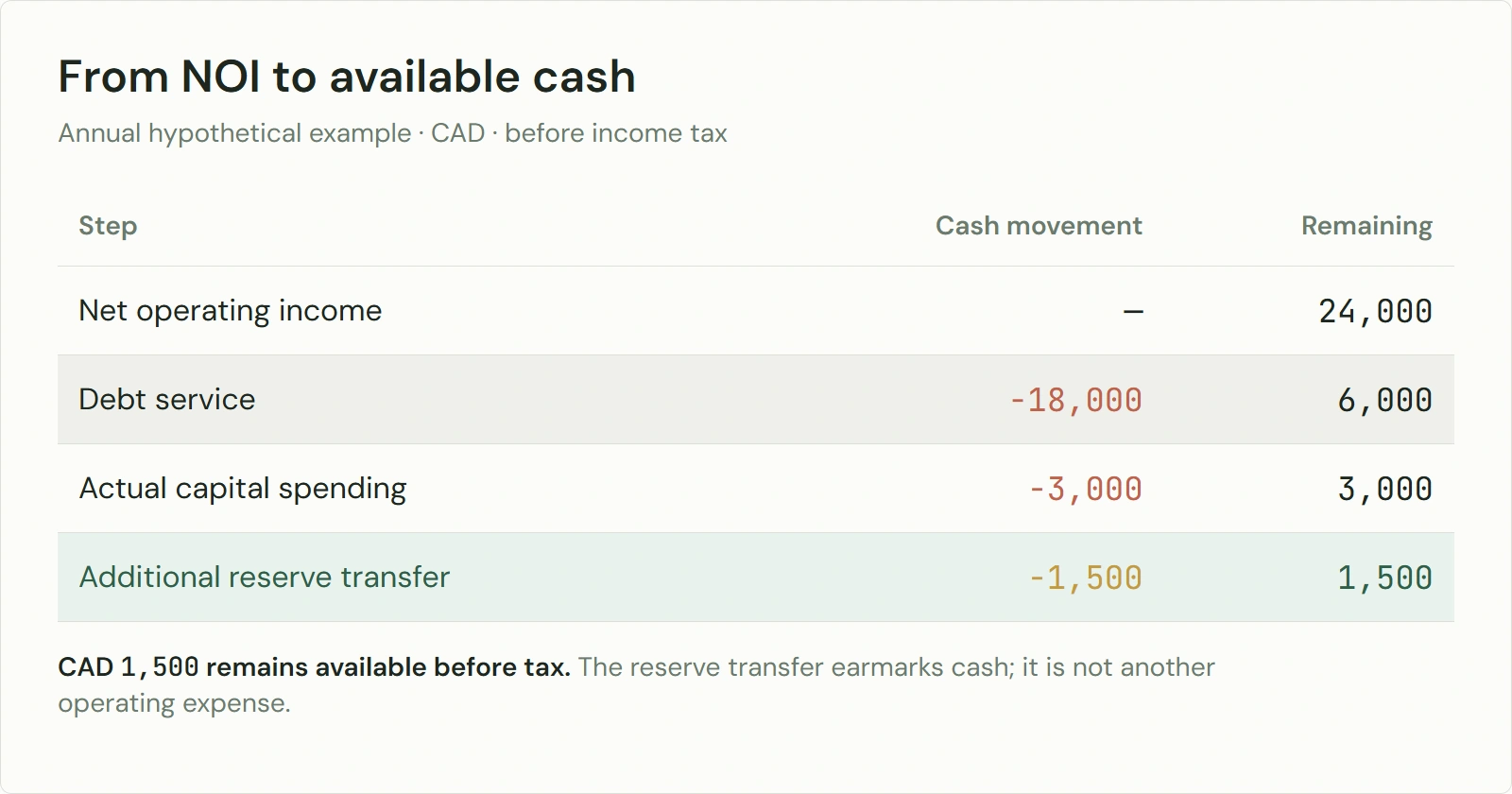
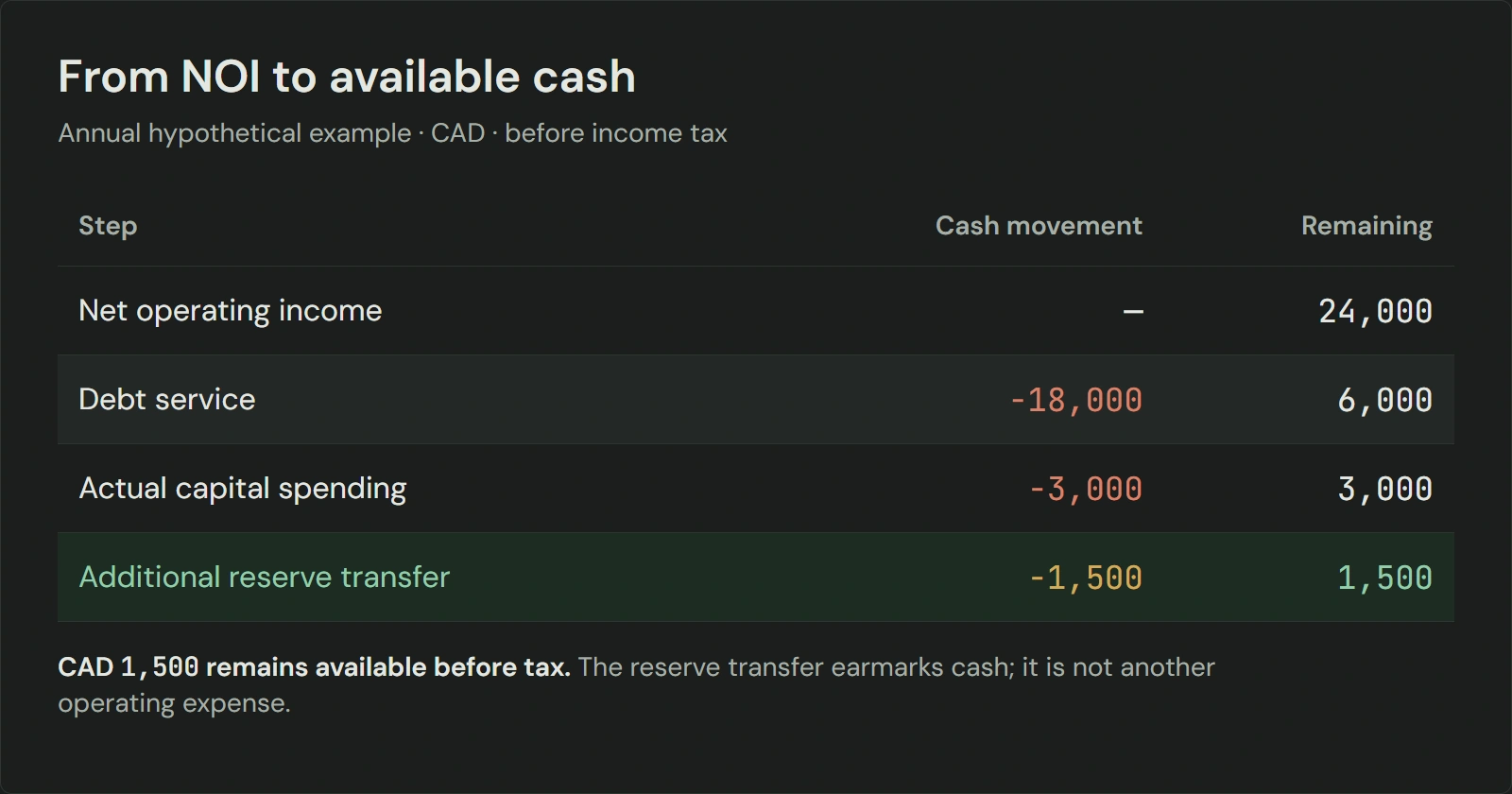
These figures are invented teaching inputs. They are not market averages or a return promise.
What the calculation does not include
It does not include income tax, sale proceeds, additional borrowing, or fresh owner contributions. Those belong in a broader cash reconciliation or a separately labelled after-tax calculation.
A refinancing deposit can make the bank balance rise without making operations more profitable. An owner top-up can cover a shortfall without turning property cash flow positive. Record both separately so the property cannot borrow its way into looking like it earned more rent.
Unrealized appreciation is also not operating cash. A higher valuation may matter to investment returns, but it cannot pay an invoice unless you realize or borrow against it.
Annual averages do not pay this month's bills
CAD 3,000 of annual after-CapEx cash averages CAD 250 a month. That does not mean CAD 250 appears reliably every month.
An insurance renewal, vacancy, annual tax payment, or project can create a negative month inside a positive year. Keep a short cash forecast showing payment dates, rent receipts, and available reserves alongside your annual totals.
For the immediate cash view, use actual collections and payments. For NOI analysis, a bill may be assigned to the period it relates to. Reconcile that timing difference rather than assuming every operating-income figure equals cash received.
When a change becomes actionable
There is no universal “good cash flow” amount. Consider upcoming obligations, volatility, reserves, financing changes, and the cash invested.
| Signal | Question | Possible next step |
|---|---|---|
| A one-off negative month | Timing difference, planned project, or lost income? | Check the forecast and funding already set aside |
| Repeated negative operating cash | Which income or recurring cost changed? | Diagnose the cause and build a realistic funding plan |
| Positive cash but known work is unfunded | Is cash truly available after upcoming needs? | Adjust planned distributions and reserve contributions |
| Cash improves only after borrowing/top-ups | Did operations improve at all? | Separate financing/owner inflows from property results |
Review actual cash monthly and check imminent bills sooner when liquidity is tight. Refresh the forward forecast before renewals or major work. Do not skip essential maintenance just to keep one month positive.
Cash flow is not your complete return
Principal repayment can increase equity while reducing cash. Appreciation can change value without generating current cash. Taxes can further change what the owner retains.
Use cash flow for funding and liquidity questions; combine it with other clearly defined measures when assessing investment return. Your bank account is informative, but it is not the entire investment committee.
Related guides
Sources
- Fannie Mae, DSCR guidance job aid, underwritten net cash flow and debt-service definitions, document marked October 7, 2022. US multifamily-program context; current product rules must be checked separately. Accessed October 1, 2026. It illustrates why an owner cash view and an underwriting view can differ.
Educational content, not financial, tax or legal advice.