

Canadian rental mortgages · Part 5 of 6
Negotiate a refinance: incentives are only part of the deal
Compare refinance rates, fees, cashback and early-exit costs. A worked rental example separates payment relief from the full financing-cost break-even.


Negotiate the rate, the borrowing terms and the total cost of moving. Cashback and fee credits matter only after you establish eligibility, receipt dates and repayment conditions. A lower-rate refinance can still leave you worse off if you exit before its interest savings repay the costs.
Start by asking each lender for the same rental transaction in writing. Then compare the financing cost over the period you reasonably expect to keep the loan.
Give competing lenders the same request
Specify the property’s rental use and unit count, borrower, amount, remaining amortization, term, payment frequency and expected funding date. State whether you want additional cash. Separate a transfer at maturity from a refinance before maturity; the transaction guide explains why that distinction affects the comparison.
Record the rate and, for a variable product, the lender-prime spread. Ask about permitted extra payments, portability, conversion and the break-charge formula. Request an expiry date and all approval conditions. If flexibility matters because you may sell soon, give that fact the same attention as the interest rate.
FCAC recommends negotiating at renewal and asking whether the receiving lender will cover switching costs. Treat the response as a written offer to verify, not an assumption that every refinance comes with legal or appraisal credits.
Read the promotion’s transaction rules
As checked October 1, 2026, CIBC’s public cashback page lists an application window from July 30 to November 1, 2026, funding within 120 days and cashback deposited six to eight weeks after funding. Its terms limit this offer to owner-occupied residential properties and explicitly exclude commercial/investment properties and properties that are not owner-occupied. Purchases and eligible transfers are listed; mortgage-broker referrals are excluded. This advertised offer therefore does not establish a rebate for an ordinary non-owner-occupied rental refinance. The offer can change or be withdrawn.
Do not copy a purchase promotion into a refinance spreadsheet. Ask which transaction qualifies, which fees are reimbursed, whether a particular account is required, when cash arrives and what happens on an early payout. The educational example below is invented and is not that CIBC promotion.
A refinance with a modest apparent advantage
Consider a separate before-maturity case: a CAD 400,000 rental mortgage has 25 years of remaining amortization and 36 months left at a fixed 5%. A hypothetical replacement offers a fixed 4.6% for the same 36-month comparison. Both use nominal rates compounded semi-annually and monthly payments. There is no extra borrowing.
Assume these costs and credits are paid from or received into cash, not added to the new principal:
| Moving cost or credit | CAD |
|---|---|
| Old loan’s written break charge | 5,000 |
| Legal cost | 1,200 |
| Appraisal | 300 |
| Discharge/administration | 300 |
| Total costs | 6,800 |
| Confirmed fee credit | −800 |
| Confirmed cashback | −2,000 |
| Net moving cost | 4,000 |
These are hypothetical quotes. The CAD 5,000 charge is stipulated, not estimated from the interest rate. The credits have no assumed clawback while the loan is kept for 36 months. No costs differ apart from those listed. Tax, time value, reinvestment of payment savings and subsequent terms are excluded.
The old loan’s calculated payment is CAD 2,326.42; the replacement’s is CAD 2,236.18. Payment relief is approximately CAD 90.24 a month. Dividing CAD 4,000 by CAD 90.24 suggests about 44.33 months to recover the outlay through payment relief alone. That arithmetic extends the payment difference beyond the 36-month term, when new payment terms are unknown. It does not measure the full financing benefit, because the replacement also reduces debt faster.
Over 36 months, interest on the old loan is CAD 57,540.81 and on the replacement CAD 52,886.09. Interest saving is CAD 4,654.72. After CAD 4,000 net costs, the nominal financing advantage is only CAD 654.72. Ending balances are CAD 373,789.69 and CAD 372,383.50 respectively.
You can verify that advantage by comparing total payments plus ending debt plus net costs. Principal repayment appears through the ending debt, so it is not added as a second expense.
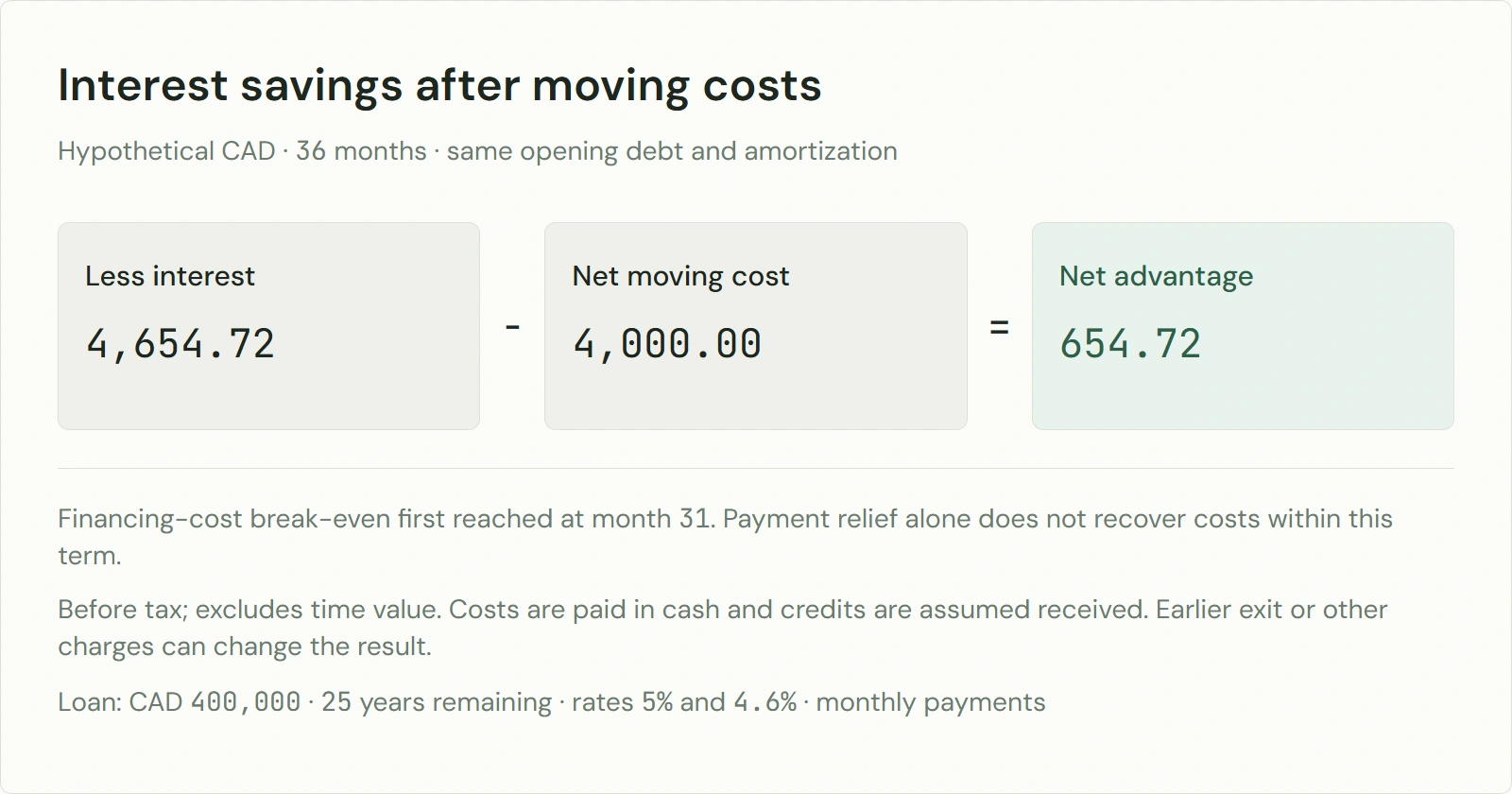
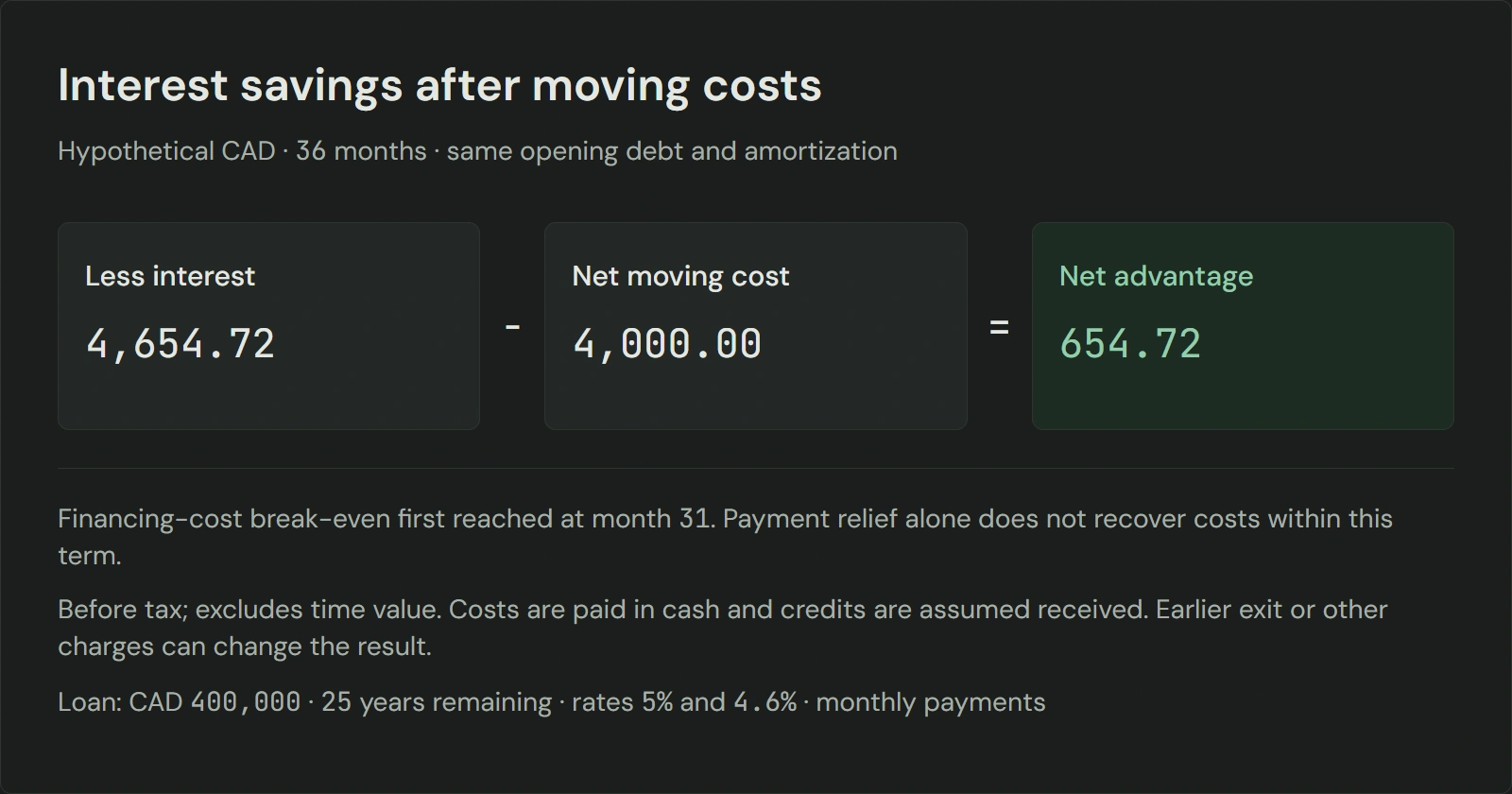
Find the break-even point for the right measure
For each month, subtract replacement-loan cumulative interest from old-loan cumulative interest. The financing-cost comparison reaches break-even when that saving covers net costs:
Here, is cumulative interest saving in CAD through month , and is net moving cost in CAD. Under this schedule, the first whole month meeting the CAD 4,000 test is month 31. That is a nominal financing-cost boundary, not a guarantee or the date the initial cash has returned to your account.
At month 24, interest saving is approximately CAD 3,116.30, leaving a CAD 883.70 shortfall against moving costs. If you sell then, add any new-loan break charge and incentive repayment under each option’s contract. Include costs of ending the old loan in the stay-put path as well. An early sale can change both sides of the comparison.
FCAC’s mortgage-break guidance notes that cashback may need repayment separately from other break costs. Obtain the actual clause and model the early-exit date; do not assume the rebate is yours to keep indefinitely.
Cash timing needs its own check
Suppose the CAD 800 credit applies at closing, while CAD 2,000 cashback arrives later. You need CAD 6,000 at closing, even though eventual net cost is CAD 4,000. If a credit is a later reimbursement instead, initial cash needs rise again.
If fees enter the mortgage, rerun the schedule with the larger opening balance. Interest on financed costs changes the result. If extra equity is advanced, assess the new debt and use of money separately; borrowing rental equity is not financing profit.
Make the negotiation reviewable
Before accepting, get one written sheet showing rate/spread, term, balance, amortization, payment, fees, credits, receipt dates, clawbacks, privileges and approval conditions. Ask the competing lender to address the terms that matter to your plan. Check whether an improvement in one line creates a restriction elsewhere.
Refresh the old lender’s dated payout quote, rerun the comparison using actual figures and stress an earlier exit. A small advantage such as this example deserves particular attention to omitted charges and changing dates.
Sources
- FCAC — Renewing your mortgage. Current page checked. Accessed October 1, 2026.
- CIBC — Mortgage cashback offer. Applications July 30 to November 1, 2026; funded within 120 days; directly checked 2026-10-01. Accessed October 1, 2026.
- FCAC — Breaking your mortgage contract. Page dated 2025-10-15; directly checked 2026-10-01. Accessed October 1, 2026.
Educational content, not financial, tax or legal advice.